How Australian Crypto Taxes Work: What the ATO Actually Requires in 2026
The ATO treats crypto as property—an asset, not currency. Every sale, swap, or spend triggers a Capital Gains Tax (CGT) event that must be reported on your tax return.
Here's how Australian crypto taxation works, what you owe, and when you owe it.
The ATO Classification: Property, Not Currency
The ATO classifies cryptocurrency as property under Australian tax law. This means crypto is taxed like shares or real estate—not like dollars in your bank account.
This classification applies to:
- Cryptocurrency coins (Bitcoin, Ethereum, Solana)
- Tokens
- NFTs
- Stablecoins
- Wrapped tokens
- DeFi assets
The ATO doesn't care what you call it. If it's a digital asset on a blockchain, it's property.
Can the ATO Track Your Crypto?
Yes. The ATO's data-matching program has been running since 2014 and extends through the 2025-26 financial year.
The ATO collects transaction data from Australian exchanges including:
- Personal information (name, address, DOB, contact details)
- Account data (status, linked bank accounts, wallet addresses)
- Transaction data (date, time, type, amounts, balances)
Exchanges participating: Binance, CoinSpot, CoinJar, and others operating in Australia.
Scale: The ATO tracks data on 1.2 million Australians from crypto exchanges. They cross-reference this with tax returns to identify non-compliance.
They already know what you traded on centralized exchanges.
What Triggers a Tax Event
Key point: Wrapping tokens (e.g., SOL to wSOL) is a CGT event in Australia. The ATO confirmed this triggers a disposal.
Capital Gains Tax Rates in Australia
CGT is not a separate tax rate. Capital gains are added to your taxable income and taxed at your marginal income tax rate.
2025-26 Income Tax Rates
Plus 2% Medicare Levy for most taxpayers
The 50% CGT Discount
This is the biggest tax advantage for Australian crypto investors.
Hold crypto for more than 12 months before selling? You only pay tax on half the gain.
Example:
- Buy 1 SOL for $100
- Sell 14 months later for $300
- Capital gain = $200
- With 50% discount: Only $100 added to taxable income
Requirements:
- Hold the asset for at least 12 months (excludes acquisition and disposal dates)
- Only available to individual investors (not classified as traders)
- Cannot apply to short-term holds
At a 30% marginal rate, the effective tax on long-term crypto gains drops to 15%. At the 45% bracket, it drops to 22.5%.
How to Calculate Capital Gains
Capital Gain/Loss = Proceeds (FMV in AUD) – Cost Basis
Example: Buy 1 SOL for $100. Sell it for $150. Capital gain = $50.
If you held for more than 12 months, only $25 is added to your taxable income (50% discount).
Cost Basis Methods in Australia
Unlike Canada (which mandates ACB), Australia allows multiple cost basis methods for investors.
Important: If you're classified as a trader (crypto is your primary income source), only FIFO is permitted.
What's included in cost basis
- Purchase price (AUD equivalent at time of acquisition)
- Transaction fees (both purchase and sale)
- Gas fees
Use the same method consistently. Switching methods to minimize tax in a particular year may attract ATO scrutiny.
Ordinary Income: When Crypto is Received
Crypto received as income is taxed at fair market value (FMV) the moment you gain control over it. Unlike capital gains, income has no 50% discount—it's fully taxable at your marginal rate.
The FMV becomes your cost basis. If you earn $100 of SOL today and sell it later for $150, you pay income tax on the first $100 and capital gains tax on the $50 profit.
Staking rewards
Staking rewards are ordinary income taxed at FMV (in AUD) when you receive them. The FMV becomes your cost basis for future CGT when you sell.
Airdrops
Treatment varies:
- Most airdrops — Ordinary income at FMV when received
- Initial allocation airdrops (tokens not previously trading) — Tax-free at receipt; entire proceeds become gains on disposal (cost basis = $0)
Using Losses to Offset Gains
Capital losses from selling crypto can offset capital gains from digital assets, shares, property, or other assets.
If losses exceed gains: You can carry losses forward indefinitely to offset future capital gains. You cannot use capital losses to offset regular income.
Tax-loss harvesting before June 30: Sell underwater positions before the financial year ends to realize losses. Use those losses to offset gains from profitable trades.
Wash Sales in Australia
Australia has no formal wash sale rule with a specific timeframe like the US 30-day rule.
However, the ATO uses Part IVA anti-avoidance provisions to target wash sales based on intent:
- Selling at a loss and immediately rebuying the same asset to claim a tax benefit = wash sale
- ATO uses "advanced analytics" to identify suspicious patterns
- The ATO specifically lists wash sales among targeted schemes in its 2026 compliance program
Penalties: Additional tax, interest, and penalties for those caught.
Safe approach: Wait 45+ days before repurchasing the same asset after selling at a loss.
Personal Use Asset Exemption
The ATO allows a CGT exemption for personal use assets acquired for $10,000 or less.
Requirements (all must be met):
- Acquisition cost $10,000 or less
- Crypto acquired primarily for personal use (not investment)
- Used directly to purchase goods/services (not converted to AUD first)
- Used within a short timeframe (same day or within two weeks)
Critical ATO Position: The ATO explicitly states it is "unlikely that a taxpayer would genuinely satisfy the personal use asset exemption."
In practice, if you held crypto hoping it would increase in value, it's an investment—not personal use. Don't rely on this exemption.
Important: Capital losses on personal use assets cannot be used to offset other gains.
Required ATO Forms
No separate crypto tax form exists. Report on standard income tax forms:
Filing options:
- myTax portal — ATO's online system via myGov
- Registered tax agent — Extended deadlines available
- Paper forms — NAT 2541
Key Deadlines (2025-26 Financial Year)
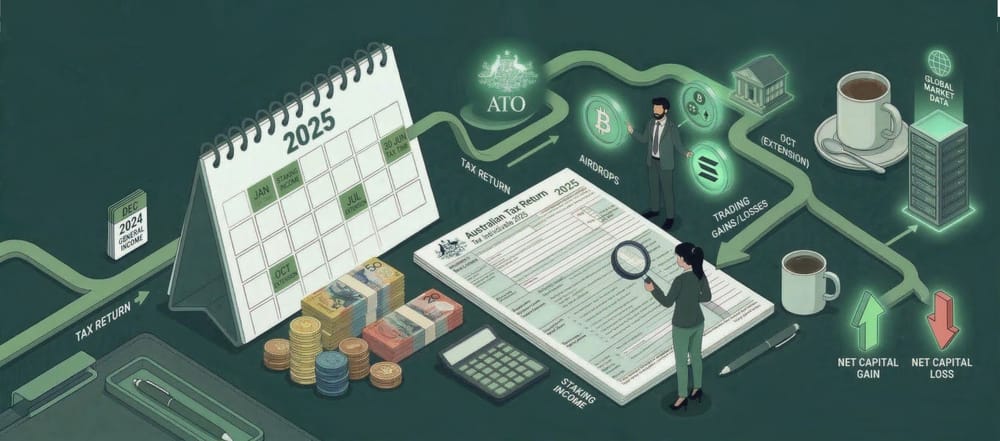
Important: Australia's financial year runs July 1 – June 30, not January – December. Plan your tax-loss harvesting before June 30, 2026.
Penalties for Not Reporting
The ATO has your exchange data. Claiming you "didn't know" crypto was taxable won't work as a defense.
Strategies to Reduce Your Crypto Tax Bill
- Hold for 12+ months — Get the 50% CGT discount. At a 30% marginal rate, your effective rate drops to 15%
- Use HIFO cost basis — Sell highest-cost units first to minimize gains
- Tax-loss harvest before June 30, 2026 — Realize losses to offset gains (wait 45+ days to rebuy)
- Time disposals around financial year end — Defer gains to next year if beneficial
- Donate appreciated crypto — May qualify for deductions
- Carry losses forward — Losses carry forward indefinitely to offset future gains
- Stay under the tax-free threshold — If total income under $18,200, no tax owed
Record Keeping
The ATO requires records for 5 years from the date you lodge your return. Keep documentation showing:
- Date of each transaction
- Value in AUD at time of transaction
- Purpose of transaction
- Wallet addresses
- Exchange records
- Transaction hashes
The ATO already has your exchange data. Your records need to match what they have.
DeFi Transactions
DeFi creates complexity. Here's how the ATO views common activities:
LP Deposits and Withdrawals
Depositing tokens into a liquidity pool and receiving LP tokens may trigger a CGT event (you're exchanging one asset for another). Withdrawing triggers another CGT event.
Yield and Rewards
- Token-based rewards (receive new tokens): Ordinary income at FMV when received
- Value-based rewards (LP tokens increase in value): CGT on disposal
Wrapping Tokens
CGT event. The ATO confirmed that wrapping (e.g., SOL to wSOL) is a disposal. Even though you're getting an equivalent asset, it's technically a swap.
Staking
- Depositing for staking: Generally not a CGT event if you retain beneficial ownership
- Receiving staking rewards: Ordinary income at FMV when received
- The FMV becomes your cost basis for future CGT
Investor vs. Trader Classification
Your classification determines your tax treatment:
Most people are investors. If you trade daily as your primary income source, you may be classified as a trader—consult an accountant.
Summary
Australian crypto taxes come down to three rules:
- Property treatment — Every sale, swap, or spend triggers CGT
- 50% discount for 12+ months — Hold longer, pay less
- ATO has your data — 1.2 million Australians tracked via exchange data-matching
The ATO is actively enforcing crypto compliance. Report everything.
File Your Solana Taxes Without the Headache
Tracking crypto taxes manually breaks at a few hundred transactions. DeFi swaps, staking rewards, NFT trades, LP positions—each one needs cost basis calculations in AUD and holding period tracking for the 50% CGT discount.
Netrunner handles this automatically for Solana.
Connect your wallets, wait a few minutes for indexing (~60,000 transactions in ~5 minutes), and get accurate capital gains, income, and expense reports ready for filing.
What you get:
- Auto-labeling for swaps, staking, LPs, NFTs, and DeFi transactions
- FIFO, LIFO, and HIFO cost basis methods
- Automatic 12-month holding period tracking for the 50% CGT discount
- ATO-compatible exports for myTax
- Support for Coinbase and Binance imports
Free plan: Up to 30,000 transactions. No credit card required.
Pro plan: $189/year for up to 100,000 transactions with full reporting.
Save more. Do less.
Get started at netrunner.tax →
Disclaimer: This information is for general educational purposes only. It should not be taken as constituting professional advice from Netrunner. You should consider seeking independent legal, financial, or taxation advice to check how this information relates to your unique circumstances.