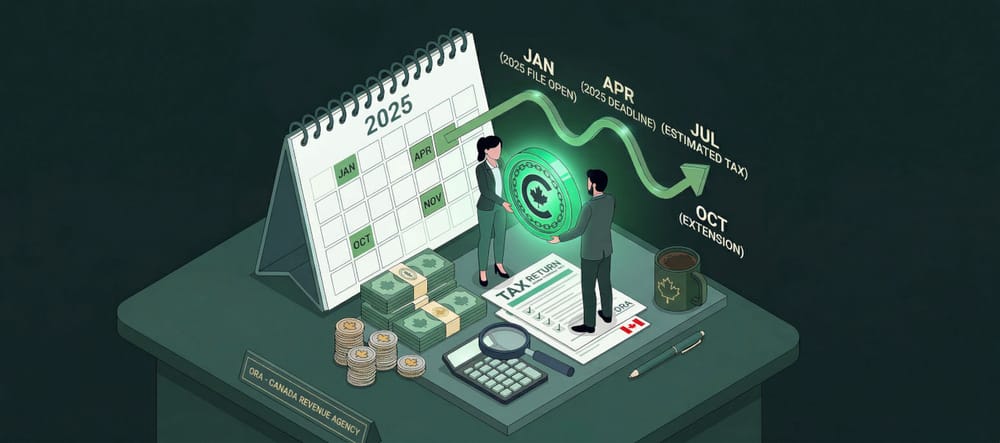
How Canadian Crypto Taxes Work: What the CRA Actually Requires in 2025
The CRA treats crypto as a commodity—property, not currency. Every sale, swap, or spend triggers a taxable event that must be reported on your tax return.
Here's how Canadian crypto taxation works, what you owe, and when you owe it.
The CRA Classification: Property, Not Currency
The CRA classifies cryptocurrency as a commodity under the Income Tax Act. This means crypto is taxed like stocks or real estate—not like dollars in your bank account.
The CRA's 2025-26 Departmental Plan identifies crypto-assets as an "emerging high-risk area" with commitments to "take all necessary measures to root out non-compliance."
Translation: they're paying attention.
Can the CRA Track Your Crypto?
Yes. The Crypto-Asset Reporting Framework (CARF) takes effect January 1, 2026. Crypto service providers operating in Canada must report:
- User information (name, address, DOB, tax ID)
- Annual value of crypto-to-fiat exchanges
- Crypto-to-crypto exchanges
- Transfers over $50,000 USD
First reports due in 2027 for the 2026 calendar year. The CRA will know what you traded.
What Triggers a Tax Event
Key point: Using crypto to buy NFTs triggers a taxable event. You're swapping one property for another—the CRA sees a disposal.
Capital Gains Inclusion Rate: 50%
Canada uses a 50% inclusion rate for capital gains. Only half of your gain is added to taxable income.
The proposed increase to 66.67% was cancelled in March 2025 by Prime Minister Mark Carney. The rate stays at 50%.
Example: You sell crypto for a $10,000 profit. $5,000 is added to your taxable income and taxed at your marginal rate.
2025 Federal Tax Brackets
Provincial rates stack on top. Combined rates range from ~44% (Nunavut) to ~54% (Nova Scotia) at the highest brackets.
Effective capital gains rate: At a 50% combined marginal rate, your effective rate on capital gains is ~25% (50% inclusion × 50% tax rate).
How to Calculate Capital Gains
Capital Gain/Loss = Proceeds (FMV in CAD) - ACB (Adjusted Cost Base)
Example: Buy 1 SOL for $100. Sell it for $150. Capital gain = $50. With the 50% inclusion rate, $25 is added to your taxable income.
The Adjusted Cost Base (ACB) Method
The CRA requires ACB for all identical property. FIFO, LIFO, and HIFO are not permitted in Canada.
How ACB works
Every time you buy more of the same crypto, you recalculate the weighted average:
ACB per unit = Total cost of all units ÷ Total number of units
Example:
- Buy 1 SOL at $100
- Buy 1 SOL at $200
- Total: 2 SOL, $300 cost
- ACB per SOL = $150
When you sell 0.5 SOL for $125:
- Cost basis = 0.5 × $150 = $75
- Capital gain = $125 – $75 = $50
You can't pick which "coins" you're selling. ACB is mandatory.
What's included in ACB
- Purchase price (in CAD)
- Transaction fees and exchange fees
- For mined crypto: direct costs of earning it
- For crypto received as payment: FMV at time of acquisition
Ordinary Income: When Crypto is Received
Crypto received as income is taxed at fair market value (FMV) the moment you gain control over it. Unlike capital gains, income has no 50% discount—it's 100% taxable.
Good news: The CRA confirmed in January 2025 that depositing crypto for staking does NOT trigger a disposition if you retain beneficial ownership. However, staking rewards are still taxable as income when received.
The FMV becomes your cost basis. If you earn $100 of SOL today and sell it later for $150, you pay income tax on the first $100 and capital gains tax on the $50 profit.
The Superficial Loss Rule
Canada's equivalent of the US wash sale rule—but it actually applies to crypto.
A capital loss is denied if:
- You sell crypto at a loss
- You (or an affiliated person) buy the same crypto within 30 days before OR after the sale
- You still own it at the end of the 30th day after the sale
The 61-day window:
- 30 days before sale + sale date + 30 days after = 61 days
What happens to denied losses:
The loss is added to the ACB of the repurchased crypto. You get the benefit when you eventually sell without triggering the rule again.
How to avoid:
- Wait 31 full days before rebuying the same crypto
- Buy a different crypto during the waiting period (SOL → ETH is fine)
- Stablecoins are different assets (selling SOL at a loss and buying USDC is fine)
Using Losses to Offset Gains
Capital losses from selling crypto can offset capital gains from digital assets, stocks, real estate, or other property.
If losses exceed gains: You can carry losses back 3 years or forward indefinitely to offset capital gains in other years. You cannot use capital losses to offset regular income (except in year of death).
Tax-loss harvesting works in Canada—but watch the superficial loss rule. You must wait 31 days before rebuying the same asset.
Burning Worthless Tokens and NFTs
Got rugged? Holding worthless tokens?
You cannot claim depreciation on unrealized losses. The only way to realize a loss is by disposing of the asset:
- Tokens: Swap them for another token on an exchange, or burn them
- NFTs: Burn them to realize the loss
Burning triggers a disposal. You realize the loss and can use it to offset gains.
Gift Tax in Canada
Canada has no gift tax. However, gifting crypto triggers a disposition for the giver at FMV.
For the giver:
- Treated as selling at FMV
- Capital gains calculated as: FMV – ACB
- You may owe tax on the "phantom" gain
For the recipient:
- Cost basis = FMV at time of gift
- No tax due until they dispose
Charitable donations:
- Crypto donated to registered charities is NOT taxable
- May qualify for donation tax credit based on FMV
Required CRA Forms
T1135: Foreign Property Reporting
If your specified foreign property exceeds $100,000 CAD total cost at any time during the year, you may need to file Form T1135.
The CRA's view: crypto may be "foreign property" depending on where it's held. Crypto on non-Canadian exchanges likely requires T1135.
Two tiers:
- Part A (simplified) for $100K–$250K
- Part B (detailed) for $250K+
Penalties for late filing: $25/day up to $2,500; gross negligence penalties up to $12,000.
Consult your accountant if your holdings approach this threshold.
Key Deadlines (2025 Tax Year)
Important: If you or your spouse is self-employed, you get the June 15 filing extension, but any balance owing is still due April 30 to avoid interest charges.
Penalties for Not Reporting
The CRA shares data with international tax authorities. Starting 2026, CARF reporting means they'll receive transaction data directly from crypto service providers.
Strategies to Reduce Your Crypto Tax Bill
- Use the 50% inclusion rate — Capital gains are already taxed at half compared to regular income
- Tax-loss harvest before Dec 31 — Sell losers to offset winners (wait 31 days to rebuy same asset)
- Donate appreciated crypto — Deduct full FMV for assets donated to registered charities
- Self-directed RRSP/TFSA — Some platforms allow crypto in registered accounts (gains grow tax-free or tax-deferred)
- Carry losses back or forward — Losses can offset gains in past 3 years or future years indefinitely
- Track ACB accurately — Proper cost basis means no overpaying on gains
Record Keeping
The CRA requires records for 6 years. Keep documentation showing:
- Purchase dates and amounts
- Fair market value at transaction time
- ACB calculations
- Transaction fees
- Wallet addresses and transaction hashes
Store raw CSVs, wallet exports, and FMV sources (CoinGecko API snapshots). They pass audit tests.
DeFi Transactions
DeFi creates complexity. Here's how the CRA views common activities:
LP Deposits and Withdrawals
The CRA considers LP deposits and withdrawals as dispositions (exchange of property). Each contribution/withdrawal can trigger capital gains.
Yield and Rewards
- Value-based rewards (LP tokens increase in value): Taxed on withdrawal
- Token-based rewards (receive new tokens): Likely income at FMV when received
Staking
- Depositing for staking: NOT a disposition (if you retain beneficial ownership)
- Receiving staking rewards: Taxable income at FMV when received
- The FMV becomes your cost basis for future capital gains
Summary
Canadian crypto taxes come down to three rules:
- Property treatment — Every sale, swap, or spend triggers capital gains
- 50% inclusion rate — Only half of capital gains are taxable
- ACB is mandatory — No choosing cost basis methods; weighted average only
Starting 2026, CARF reporting means the CRA gets transaction data directly from crypto platforms. Report everything.
File Your Solana Taxes Without the Headache
Tracking crypto taxes manually breaks at a few hundred transactions. DeFi swaps, staking rewards, NFT trades, LP positions—each one needs ACB calculations in CAD and proper labels.
Netrunner handles this automatically for Solana.
Connect your wallets, wait a few minutes for indexing (~60,000 transactions in ~5 minutes), and get accurate capital gains, income, and expense reports ready for filing.
What you get:
- Auto-labeling for swaps, staking, LPs, NFTs, and DeFi transactions
- Proper ACB calculations (the only method CRA allows)
- Schedule 3 compatible exports
- Support for Coinbase and Binance imports
Free plan: Up to 30,000 transactions. No credit card required.
Pro plan: $189/year for up to 100,000 transactions with full reporting.
Save more. Do less.
Get started at netrunner.tax →
Disclaimer: This information is for general educational purposes only. It should not be taken as constituting professional advice from Netrunner. You should consider seeking independent legal, financial, or taxation advice to check how this information relates to your unique circumstances.