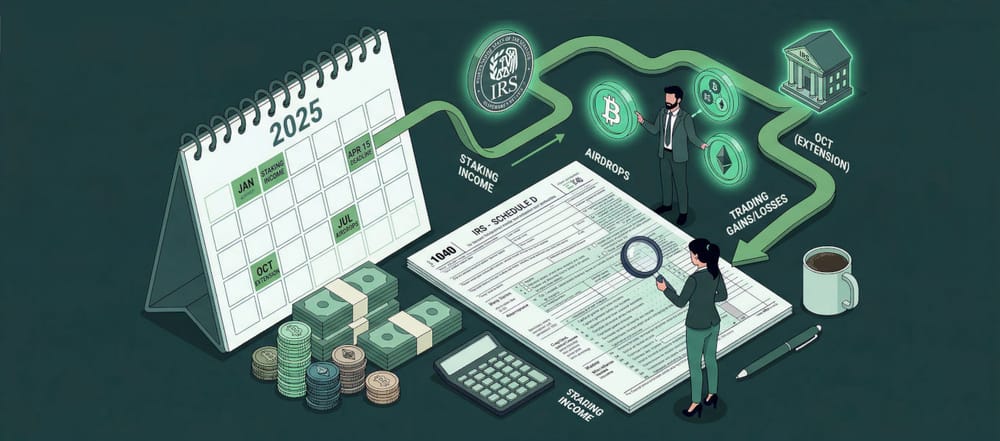
How US Crypto Taxes Work: What the IRS Actually Requires in 2025
The IRS treats crypto as property, not currency. Every sale, swap, or spend triggers a taxable event. This isn't optional—it's federal law.
Here's how US crypto taxation works, what you owe, and when you owe it.
The IRS Classification: Property, Not Currency
The IRS classifies digital assets (cryptocurrency, stablecoins, NFTs) as property. This means crypto is taxed like stocks or real estate—not like dollars in your bank account.
Form 1040 now asks directly: "At any time during 2025, did you receive, sell, send, exchange, or otherwise acquire any financial interest in any virtual currency?"
Check "yes" and the IRS expects to see corresponding income on your return. A wrong answer could result in penalties.
Can the IRS Track Your Crypto?
Yes. Centralized exchanges report to the IRS as part of Anti-Money Laundering (AML) and Know Your Customer (KYC) requirements.
In 2018, Coinbase was hit with a court order to provide account information for 13,000 users. In September 2022, the IRS obtained a court order for records from the SFOX exchange.
Starting January 1, 2025, brokers must issue Form 1099-DA for all crypto trades. They'll collect your Form W-9 to verify your tax ID. If you've on or off-ramped or traded on a centralised exchange, the IRS will know you've traded crypto and will expect to see it on your tax forms.
What Triggers a Tax Event
Key point: Using crypto to buy NFTs triggers a taxable event. You're swapping one property for another—the IRS sees a disposal.
2025 Short-Term Capital Gains Tax Rates
Short-term gains (held 12 months or less) are taxed at ordinary income rates:
2025 Long-Term Capital Gains Tax Rates
Long-term gains (held more than 12 months) get preferential rates:
The 0% bracket matters: If your total income plus gains stays under $48,350 (single), you pay zero federal tax on long-term crypto gains.
High earners add 3.8% NIIT: Net Investment Income Tax applies to the lesser of net investment income or the amount over $200k (single) / $250k (married filing jointly).
How to Calculate Capital Gains
Capital Gain/Loss = Proceeds (FMV at sale) - Cost Basis (purchase price + fees)
Example: Buy 1 SOL for $100. Sell it for $150. Capital gain = $50.
If you sold within a year, that $50 is taxed at your ordinary income rate (up to 37%). Hold longer than a year and it drops to 0-20%.
Cost Basis Methods
Important: You can only use one cost basis method per tax year. HIFO generally adds the most value for standard crypto investors—it harvests larger losses first.
Starting January 1, 2025, broker-custodied accounts default to FIFO unless you specify otherwise.
Ordinary Income: When Crypto is Received
Crypto received as income is taxed at fair market value (FMV) the moment you gain control over it.
The FMV becomes your cost basis. If you earn $100 of SOL today and sell it later for $150, you pay income tax on the first $100 and capital gains tax on the $50 profit.
Using Losses to Offset Gains
Capital losses from selling crypto can offset capital gains from digital assets, stocks, real estate, or other property.
If losses exceed gains: You can deduct up to $3,000 ($1,500 if married filing separately) against ordinary income annually. Remaining losses carry forward indefinitely.
Tax-loss harvesting works: Sell underwater positions before December 31 to realize losses. The wash sale rule does not currently apply to crypto—unlike stocks. You can sell at a loss in December and repurchase in January without losing the deduction.
Burning Worthless Tokens and NFTs
Got rugged? Holding worthless tokens?
You cannot claim depreciation on unrealized losses. The only way to realize a loss is by disposing of the asset:
- Tokens: Swap them for another token on an exchange, or burn them
- NFTs: Burn them using tools like Sol Incinerator
Burning triggers a disposal. You realize the loss and can use it to offset gains.
Gift Tax Exclusion
US taxpayers can gift crypto tax-free up to the annual exclusion limit:
Gift to each recipient up to the limit with no gift tax implications. The recipient's cost basis becomes your original cost basis.
Required IRS Forms
Even without a 1099-DA, you must report all crypto transactions—including DeFi trades, P2P transactions, and self-custody wallet activity.
State Tax Considerations
43 states piggy-back on federal AGI. Your crypto gains flow through automatically.
No state income tax? (FL, TX, WY, NV, etc.) You still owe federal tax. If you relocate, capital gains incurred before moving may remain sourced to your old state.
States like NY and CA have their own rules. Check resident credit requirements if you moved mid-year.
Key Deadlines
Penalties for Not Reporting
The Form 1040 digital asset question creates a paper trail. Checking "no" when you should check "yes" is a false statement on a federal return.
Strategies to Reduce Your Crypto Tax Bill
- Hold more than 12 months — Drop from 37% to 0-20%
- Tax-loss harvest before Dec 31 — Sell losers to offset winners
- Use HIFO cost basis — Realize losses first
- Donate appreciated crypto — Deduct full FMV for assets held >1 year
- Self-directed IRA/401(k) — Gains grow tax-deferred
Record Keeping
The IRS requires documentation showing:
- Purchase dates and amounts
- Fair market value at transaction time
- Cost basis calculations
- Holding periods
- Transaction fees
Keep records for at least 3 years (7 years if you claim a loss). Store transaction hashes and FMV sources—they pass audit tests.
Summary
US crypto taxes come down to three rules:
- Property treatment — Every sale, swap, or spend triggers a tax
- Income at receipt — Staking, airdrops, and payments are taxed when received
- Holding period matters — Hold over a year for preferential rates (0-20% vs. up to 37%)
Starting 2025, brokers report directly via Form 1099-DA. The IRS has your data. Report everything.
File Your Solana Taxes Without the Headache
Tracking crypto taxes manually breaks at a few hundred transactions. DeFi swaps, staking rewards, NFT trades, LP positions—each one needs a cost basis, fair market value, and proper label.
Netrunner handles this automatically for Solana.
Connect your wallets, wait a few minutes for indexing (60,000 transactions in ~5 minutes), and get accurate capital gains, income, and expense reports ready for filing.
What you get:
- Auto-labeling for swaps, staking, LPs, NFTs, and DeFi transactions
- FIFO, LIFO, and HIFO cost basis methods
- Form 8949, Schedule D, and TurboTax-ready exports
- Support for Coinbase and Binance US imports
Free plan: Up to 30,000 transactions. No credit card required.
Pro plan: $189/year for up to 100,000 transactions with full reporting.
Save more. Do less.
Get started at netrunner.tax →
Disclaimer: This information is for general educational purposes only. It should not substitute for legal, tax, or accounting advice from a licensed professional. Consult a qualified tax professional for your specific situation.