Memecoin Taxes on Solana: A Practical Guide
Most memecoin traders on Solana had a rough year.
A handful of wins, a lot of losses, and portfolio's that ended up roughly where they started.
What traders are discovering now is that a breakeven year can still come with a serious tax bill.The reason has everything to do with how the IRS counts your trades.
Every memecoin trade is a taxable event
Let's say you bought a token for 0.02 SOL and sold it 40 minutes later for 0.15 SOL. That's a taxable disposal.
You swapped one memecoin directly for another. That's two taxable events, because the swap is treated as selling one and buying another.There is no minimum threshold. No "it was only a few dollars" exception. Every sell, every swap, every DEX route from one token to another is a capital gains or loss event.With memecoins, the holding period is almost always measured in minutes or hours, which means short-term capital gains taxed at your ordinary income rate.
Cost basis when you sniped at launch
When you buy a token within seconds of launch, the price is near zero. Your cost basis is whatever you actually paid, denominated in USD at the time of the transaction.Say you sniped a new token for 0.5 SOL when SOL was at $140. Your cost basis is $70 plus transaction fees. You sold two hours later for 3 SOL when SOL was at $142.
- Proceeds: $426.
- Taxable gain: roughly $356.
Both the cost basis and proceeds need to be calculated in USD at the moment of each transaction.
The price of SOL moves between your buy and your sell, so day-average pricing doesn't cut it. This is what makes manual tracking impossible at volume.
"I traded 50 memecoins this month"
You ape into memecoins for a few weeks. A handful go up 10x and you sell.
Most go to zero and you're still holding the dead tokens. Others you swapped into different memecoins. A few you sold for SOL and used that SOL to buy more.Each action is its own line item. Fifty tokens in a month can easily mean 200+ taxable events, each with its own cost basis, proceeds, and holding period.You can't track this by hand.
You need every transaction timestamped, every token priced at the moment of each trade, and every cost basis calculated in sequence because later trades depend on earlier ones.
What about tokens that went to zero?
A dead memecoin sitting in your wallet is an unrealized loss, it doesn't count on your tax return until you actually dispose of it.Even selling a token for dust counts.
Swap it for a fraction of a cent worth of SOL and that triggers a capital loss equal to your cost basis minus whatever you received.
Bought in for $50 of SOL and sold the dead token for $0.001? That's a $49.999 capital loss you can use to offset gains.In the US, net capital losses beyond your gains offset up to $3,000 of ordinary income per year, with the rest carrying forward.
PumpFun launch fees and creation costs
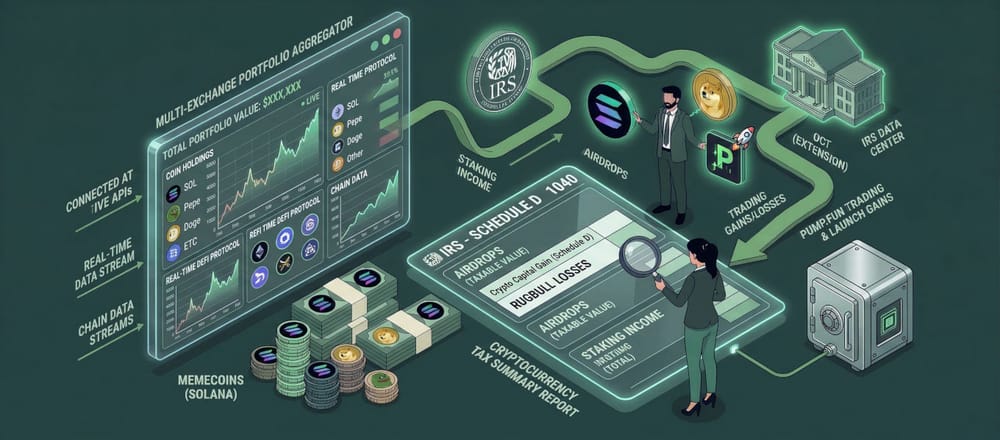
If you launched a token on @Pumpfun the creation fee is a cost. How it's treated depends on what happened next.If you created a token and sold it for a profit, the launch fee becomes part of your cost basis for that token. You'd subtract it from your proceeds when calculating your gain.If you created a token that went nowhere and has no value, the fee is effectively a loss. The specific treatment varies by jurisdiction, but in most cases you'd need to dispose of or abandon the token to claim the deduction.Transaction fees on Solana, the small SOL amounts charged for each swap, are generally added to your cost basis on purchases or subtracted from proceeds on sales.
They're small individually, but across hundreds of memecoin trades they add up.
The tracking problem
The rules are straightforward depending on your activity.
Applying them accurately across hundreds of transactions involving tokens that existed for two days and traded on bonding curves with non-standard pricing is where it falls apart.Most crypto tax tools weren't built for this.
PumpFun tokens, Raydium swaps, and Jupiter routes through obscure liquidity pools break them regularly.
Missing transactions, mislabeled events, cost basis calculations that don't account for the full chain of swaps.
That's where Netrunner comes in.
The short version
- Every memecoin trade is a taxable event, no matter how small.
- Cost basis is calculated in USD at the moment of each transaction.
- Dead tokens can generate claimable losses if you dispose of them.
- Launch fees factor into your cost basis.
Netrunner indexes @Pumpfun transactions, bonding curve trades, and the full chain of swaps natively.
The free tier covers up to 30,000 transactions and shows you your tax picture before you pay anything.
Your Solana taxes have never been easier. 👉 Netrunner.Tax